-
Posted on: 07 Jan 2026

-
HughesNet offers satellite internet, a vital service for many rural areas. But the burning question for potential subscribers remains: does Hughesnet have unlimited internet? This post dives deep into HughesNet's data policies, plans, and what "unlimited" truly means in the context of satellite internet, providing clarity for your decision.
Understanding HughesNet Data Policies
For many consumers, especially those in rural or underserved areas, the internet is not just a luxury but a necessity. It's the gateway to remote work, online education, telehealth appointments, staying connected with loved ones, and accessing essential services. Satellite internet providers like HughesNet have been instrumental in bridging the digital divide, bringing connectivity to places where traditional broadband options like fiber or cable simply aren't available. However, with satellite technology comes unique challenges, particularly concerning data usage and the concept of "unlimited" internet.
HughesNet, like most internet service providers (ISPs), operates on a model that involves managing network resources to ensure a consistent experience for all users. This management often translates into data caps or allowances, even for plans that are marketed with terms like "unlimited." Understanding these policies is crucial for managing expectations and avoiding unexpected charges or service slowdowns. The core of the issue lies in the inherent limitations of satellite bandwidth. Unlike terrestrial broadband, which can draw from vast underground cable networks, satellite internet relies on transmitting data to and from orbiting satellites. This process has inherent latency and bandwidth constraints. Therefore, ISPs must implement data management strategies to prevent network congestion, which can significantly degrade the user experience for everyone on the network.
In the past, satellite internet was often synonymous with strict data caps and prohibitively slow speeds once those caps were reached. While technology has advanced, and HughesNet has made strides in improving its service, the fundamental principles of managing data usage remain. The term "unlimited" in the context of satellite internet often requires a closer look. It rarely means completely unrestricted data usage without any form of limitation or consequence. Instead, it typically refers to a generous data allowance combined with a policy that allows continued access, albeit at reduced speeds, after the primary allowance is consumed. This is a critical distinction that many consumers overlook, leading to frustration when their internet performance changes unexpectedly.
This section will delve into the specifics of HughesNet's data policies. We will explore how they structure their plans, what their data allowances entail, and how they define "unlimited" access. By the end of this section, you'll have a clearer picture of the data framework within which HughesNet operates, setting the stage for a comprehensive understanding of whether their offerings truly meet the desire for unlimited internet. This foundational knowledge is key to making an informed decision about your internet service, especially if you are reliant on satellite connectivity.
HughesNet Plans and Data Allowances
HughesNet offers a range of satellite internet plans designed to cater to different user needs and budgets. While the specifics of these plans can evolve, the core structure typically involves a monthly data allowance. This allowance is the amount of data you can use at full advertised speeds before potential changes in your service occur. It's important to note that these plans are designed with a specific amount of high-speed data in mind.
As of 2025-26, HughesNet's primary plans are often categorized by their monthly data allowances. For instance, you might find plans offering 100 GB, 150 GB, or even higher monthly data caps. These figures represent the total amount of data you can download and upload at your plan's maximum speed. Think of it like a monthly data budget for your internet usage. Activities like streaming high-definition video, downloading large files, online gaming, and participating in video conferences consume a significant portion of this data. Even browsing the web and checking emails contribute to your data usage, though at a much slower rate.
Let's consider a hypothetical HughesNet plan with a 100 GB monthly data allowance. This means that for the billing cycle, you have 100 gigabytes of data available at full speed. Once you reach this threshold, your internet speeds may be reduced for the remainder of the month. This reduction is a common practice among ISPs, especially those with limited bandwidth, to manage network resources. The exact speed reduction can vary, but it's typically enough to make data-intensive activities like streaming HD video or downloading large files very slow, if not practically unusable.
The key takeaway here is that while HughesNet provides a substantial amount of data in its plans, it is not a limitless pool of high-speed data. The plans are structured around these allowances. For users who are heavy internet consumers, understanding these allowances and how they align with their typical usage patterns is paramount. For example, if you have multiple people in your household streaming Netflix in 4K, or if you frequently download large software updates or game patches, you will need to carefully assess whether a particular plan's data allowance will be sufficient.
To illustrate, let's look at some typical data consumption figures (these are estimates and can vary based on content and settings):
- Standard Definition (SD) Video Streaming: Approximately 0.7 GB per hour
- High Definition (HD) Video Streaming: Approximately 2.5 GB per hour
- 4K Ultra HD Video Streaming: Approximately 7 GB per hour
- Online Gaming (downloading/updates): Varies greatly, but large game downloads can be tens of gigabytes.
- Video Conferencing: Approximately 1-3 GB per hour
- Web Browsing: Approximately 50 MB per hour
- Email: Minimal, unless attachments are large.
These figures highlight how quickly data can be consumed. A household that streams several hours of HD video daily could easily exceed a 100 GB data allowance within a week or two. This is precisely why understanding the data allowance is the first step in answering the question about unlimited internet. HughesNet's plans are built around these specific data limits, and their "unlimited" aspect comes into play *after* this allowance is met, which is a critical distinction.
What Does "Unlimited" Mean for HughesNet?
The term "unlimited" in the context of internet service can be a source of confusion, and HughesNet is no exception. When HughesNet advertises "unlimited" data, it's crucial to understand what this entails, as it rarely means an infinite amount of high-speed data without any conditions. Instead, it typically refers to a policy that allows you to continue using the internet even after you've consumed your primary, high-speed data allowance.
HughesNet's "unlimited" data model generally works as follows: each plan comes with a specific monthly allowance of high-speed data. This is the data you can use for all your online activities without any speed degradation. Once you reach this primary data allowance, your internet speeds are typically reduced. This reduced speed is often referred to as "deprioritization" or "throttling." While you can still access the internet, activities that require significant bandwidth, such as streaming video, downloading large files, or playing online games, will become noticeably slower and may be difficult to complete.
Think of it like a highway. Your primary data allowance is like driving on the main lanes at full speed. Once you've used up your allowance, you're moved to a slower, secondary lane. You can still get to your destination, but it will take much longer. This ensures that users who haven't exceeded their allowance still have a good experience, while those who have used more data are still connected.
The "unlimited" aspect means that HughesNet does not cut off your service entirely once you hit your data cap, nor do they typically charge overage fees for exceeding your allowance (though it's always wise to check the most current terms and conditions). Instead, they throttle your speeds. This is a common strategy for satellite internet providers due to the inherent bandwidth limitations of satellite technology. Managing data this way helps maintain a usable service for all subscribers on the network.
So, when HughesNet says "unlimited," they are essentially saying:
- You have a generous monthly allowance of high-speed data.
- Once that allowance is used, your service continues, but at a reduced speed.
- You will not be cut off, and typically, you won't incur overage charges.
This is a significant improvement over older satellite internet models that had very strict data caps and would charge hefty fees for exceeding them. However, it's not the same as having truly unlimited, high-speed data like some fiber optic or cable plans might offer. For users who require consistent high speeds for demanding applications, understanding this distinction is paramount. If your internet usage is primarily light (email, basic browsing, occasional video calls), then HughesNet's "unlimited" offering might be perfectly adequate. But for heavy streamers or downloaders, the post-allowance speed reduction will be a noticeable constraint.
It's also worth noting that HughesNet often includes "Bonus Data" which is available during off-peak hours. This bonus data does not count against your primary monthly allowance, offering an additional pool of high-speed data that can be used for activities like downloading large files overnight. This is another facet of their "unlimited" approach, providing more flexibility for users. We will explore this bonus data in more detail later.
HughesNet Data Throttling and Deprioritization
The concepts of data throttling and deprioritization are central to understanding how HughesNet manages its network and its "unlimited" data offerings. While the terms are often used interchangeably, they describe slightly different mechanisms by which your internet speed can be affected after you've used your primary data allowance.
Data Throttling: This refers to the intentional slowing down of your internet connection by the ISP. When you exceed your high-speed data allowance with HughesNet, they will throttle your speeds. This means that your maximum download and upload speeds are deliberately reduced. The purpose of throttling is to conserve bandwidth for all users on the network. Satellite internet, by its nature, has limited bandwidth compared to terrestrial broadband. If everyone could use unlimited high-speed data without any checks, the network would quickly become congested, leading to slow speeds for everyone, regardless of their usage. Throttling ensures that users who have used their primary allowance can still access the internet, but at a pace that is less likely to impact the experience of those still within their high-speed data limits.
Deprioritization: This is a slightly more nuanced form of network management. Instead of a hard speed limit being imposed on your connection, your data traffic is given a lower priority compared to other users on the network. When the network is busy, users whose data has been deprioritized will experience slower speeds because their data packets are processed after those with higher priority. This often happens automatically when you exceed your data allowance. So, while your plan might still technically advertise a certain speed, the actual speed you experience can be significantly lower during peak network times if your data has been deprioritized.
For HughesNet subscribers, exceeding the monthly high-speed data allowance typically triggers both throttling and deprioritization. Your speeds are capped at a lower level, and your traffic is given less priority during periods of network congestion. The exact speeds after throttling can vary but are generally significantly reduced from the advertised speeds. For example, if your plan's advertised speed is 25 Mbps, after exceeding your data allowance, your speed might drop to 1-3 Mbps. This is usually sufficient for basic web browsing, email, and perhaps some very low-quality video streaming, but it will make high-definition streaming, large downloads, and real-time online gaming impractical.
Why is this necessary for satellite internet?
- Bandwidth Limitations: The capacity of the satellites and the ground infrastructure is finite.
- Network Congestion: Many users trying to access the internet simultaneously can overwhelm the available bandwidth.
- Fair Usage Policy: To ensure a reasonable experience for all users, especially those who are more data-conscious.
- Cost-Effectiveness: Managing data usage helps keep the service more affordable for a wider range of users.
It's important for users to be aware of their data usage. HughesNet provides tools, often through their customer portal or mobile app, to monitor your data consumption. Keeping an eye on this can help you manage your usage and avoid hitting the data cap unexpectedly, which can lead to frustration. Understanding that "unlimited" for HughesNet means "unlimited at reduced speeds after your allowance" is key to setting realistic expectations.
In 2025-26, the technology behind satellite internet continues to evolve, with newer satellites offering greater capacity. However, the fundamental challenge of distance and bandwidth remains. Therefore, policies like throttling and deprioritization are likely to persist as standard practice for managing data usage effectively across their customer base.
Alternatives to HughesNet for Unlimited Data
For users who find HughesNet's data policies restrictive, or who require truly unlimited high-speed data for their online activities, exploring alternative internet service providers is a logical step. The availability of these alternatives, however, is heavily dependent on your geographic location, particularly if you reside in a rural area where HughesNet is often one of the few available options.
1. Other Satellite Internet Providers:
While HughesNet is a major player, other satellite internet providers exist. For instance, **Viasat** is another prominent satellite ISP. Like HughesNet, Viasat offers plans with monthly data allowances. Their approach to "unlimited" data is also similar: after you use your high-speed data allowance, your speeds are reduced. However, the specific data allowances and the speeds at which they throttle can differ between Viasat and HughesNet. It's always advisable to compare the latest plans and policies from both providers if you are in a satellite-served area. Some newer satellite constellations, like Starlink (SpaceX), aim to offer higher speeds and potentially more generous data allowances, but availability and pricing can vary significantly, and their policies on unlimited data are also subject to change and network management. As of 2025-26, Starlink's "unlimited" data is also subject to deprioritization after a certain threshold, though often at higher speeds than traditional satellite.
2. Fixed Wireless Internet:
Fixed wireless internet uses radio waves to connect your home to a nearby tower. If you live in a rural or suburban area, there might be fixed wireless providers offering service. These providers often have more generous data allowances, and some even offer truly unlimited plans with no speed throttling or deprioritization. The speeds can vary depending on the provider and your distance from the tower, but they can often be competitive with or even exceed satellite speeds. Research local fixed wireless providers in your area.
3. DSL Internet:
Digital Subscriber Line (DSL) internet uses existing telephone lines to provide internet access. While DSL speeds are generally slower than cable or fiber, some DSL providers offer unlimited data plans with no caps. If DSL is available in your area, it might be a more stable and potentially less data-restricted option than satellite, though speeds might be a limiting factor for very data-intensive users.
4. Cable Internet:
Cable internet, provided through coaxial cable lines, is one of the most common and often fastest broadband options. Many cable providers offer plans with truly unlimited data, and speeds can range from moderate to extremely high. If cable is available in your location, it is usually a strong contender for unlimited, high-speed internet.
5. Fiber Optic Internet:
Fiber optic internet is the gold standard for speed, reliability, and often, unlimited data. It uses light signals transmitted through glass fibers. Fiber providers almost universally offer unlimited data with no throttling or deprioritization. However, fiber infrastructure is not as widely available as cable or DSL, especially in rural areas. If fiber is an option for you, it is highly recommended.
6. Mobile Hotspots / 5G Home Internet:
In some cases, depending on cellular coverage and data plans, using a mobile hotspot or a 5G home internet service from a cellular provider can be an alternative. Some cellular plans offer unlimited high-speed data, or at least very large allowances, which might be sufficient. However, performance can be affected by signal strength and network congestion, and some mobile plans may still have data usage policies that lead to throttling or deprioritization.
When considering alternatives, it's crucial to:
- Check Availability: Use online tools to see which providers service your exact address.
- Compare Plans: Look at advertised speeds, monthly data allowances (if any), and the terms for exceeding those allowances.
- Read Reviews: See what current customers say about reliability, customer service, and actual performance.
- Understand Contracts: Be aware of contract lengths and early termination fees.
For many in rural areas, HughesNet remains a viable option, but it's always worth investigating all available choices to find the best fit for your internet needs, especially if unlimited high-speed data is a priority.
Tips for Managing HughesNet Data Usage
If you are a HughesNet subscriber or are considering becoming one, managing your monthly data allowance effectively is key to a positive internet experience. Since HughesNet's "unlimited" data comes with a high-speed allowance followed by reduced speeds, being mindful of your usage can help you avoid the frustration of slow internet for much of the month. Here are some practical tips for managing your data consumption:
1. Monitor Your Data Usage Regularly:
HughesNet provides tools to track your data usage. Make it a habit to check your data consumption through the HughesNet customer portal or their mobile app. This allows you to see how much high-speed data you have remaining and estimate how long it will last at your current rate of usage. Knowing where you stand can help you adjust your online habits proactively.
2. Utilize Bonus Data Wisely:
HughesNet often includes "Bonus Data" that is available during off-peak hours (typically late at night). This data does not count against your primary monthly allowance. Schedule large downloads, software updates, or backups to occur during these off-peak hours. This can significantly reduce the strain on your primary data allowance.
3. Optimize Video Streaming:
Video streaming is one of the biggest data consumers.
- Lower Video Quality: If you're not in a situation where HD or 4K is essential, opt for standard definition (SD) streaming. This can reduce data consumption by up to 75% compared to HD.
- Download Content: If you have a service that allows it (like Netflix or Amazon Prime Video), download movies and shows when you have ample high-speed data or during off-peak hours to watch later.
- Limit Background Streaming: Ensure that streaming apps are not running in the background on devices when not actively being used.
4. Manage Device Updates and Background Data:
Many devices and applications automatically download updates in the background.
- Configure Automatic Updates: Set your operating systems (Windows, macOS, iOS, Android) and applications to download updates only when you are connected to Wi-Fi and have sufficient data, or schedule them for off-peak hours.
- Disable Auto-Play Videos: Many social media platforms and websites automatically play videos as you scroll. Disabling this feature can save considerable data.
- Limit Background App Refresh: On mobile devices, restrict background data usage for apps that don't require constant updates.
5. Be Mindful of Online Gaming:
Downloading games and game updates can consume tens of gigabytes. If possible, download these during off-peak hours or when you have a large amount of high-speed data remaining. Online multiplayer gaming itself consumes less data than downloads, but it's still a factor.
6. Compress Data Where Possible:
While not always feasible, some applications and services offer data compression options. For example, some web browsers have data-saving modes.
7. Use Data-Saving Features in Browsers and Apps:
Many web browsers (like Chrome, Opera) have built-in data-saving modes that compress web pages before they are sent to your device, reducing the amount of data transferred.
8. Understand What Consumes Data:
Educate yourself and your household on which activities are the biggest data hogs. A simple chart or a family discussion can go a long way in promoting mindful internet usage.
By implementing these strategies, you can make the most of your HughesNet data allowance and ensure a more consistent, high-speed internet experience throughout your billing cycle.
Real-World HughesNet Data Experiences (2025-26)
Customer experiences with internet service providers can vary widely, and HughesNet is no exception. While official plan details outline data allowances and policies, the reality of using the service day-to-day is often described through user feedback and reviews. As of 2025-26, here's a look at what real users report regarding HughesNet's data usage and the "unlimited" aspect:
1. The "Unlimited" Reality:
Many users confirm that HughesNet's "unlimited" data means they don't get cut off after hitting their high-speed allowance. This is a significant positive for those who need consistent connectivity, even if it's at slower speeds. Users generally appreciate not facing surprise overage charges or complete service interruption. However, the common sentiment is that the reduced speeds after exceeding the allowance are indeed noticeable and can be frustrating for data-intensive tasks.
2. Data Allowance Sufficiency:
For households with light to moderate internet usage, the primary data allowances offered by HughesNet (which have increased over the years) are often sufficient. Users who primarily use the internet for email, web browsing, social media, and occasional video calls report being able to stay within their high-speed data limits for most of the month. The key is often proactive data management, as discussed in the previous section.
3. Impact of Throttling:
Users who engage in frequent streaming of HD or 4K video, online gaming, or large file downloads are most likely to experience the impact of throttling. Reports often describe streaming services buffering excessively, downloads taking hours instead of minutes, and online games becoming unplayable due to lag. This reinforces the understanding that HughesNet's "unlimited" is not synonymous with "unlimited high-speed."
4. Effectiveness of Bonus Data:
The bonus data feature, available during off-peak hours, is frequently cited as a valuable component for users. Those who schedule their heavy data usage activities (like downloading game updates or streaming movies overnight) during these times report being able to manage their primary data allowance more effectively. This feature helps mitigate some of the limitations of the primary data cap.
5. Comparison to Expectations:
Many users who understand the nature of satellite internet and HughesNet's policies generally find the service meets their expectations for their specific needs. The frustration often arises when users expect unlimited high-speed data without any limitations, a misunderstanding of the "unlimited" marketing. For individuals in rural areas where other options are non-existent, HughesNet is often seen as a necessary and functional solution, despite its limitations.
6. Speed and Reliability:
Beyond data caps, user experiences with HughesNet's actual speeds and reliability can vary. While advertised speeds are typically up to 25 Mbps download, actual speeds can be lower due to satellite technology, weather conditions, and network congestion. Latency (the delay in data transmission) is also a characteristic of satellite internet, which can affect real-time applications like video conferencing and online gaming, even when within the high-speed data allowance.
7. Customer Service and Support:
Experiences with customer service are mixed, as is common with many large ISPs. Some users report satisfactory support, while others express frustration with wait times or resolution of issues. This aspect, while not directly related to data policies, contributes to the overall user experience.
In summary, the real-world experience in 2025-26 for HughesNet users suggests that the service provides a functional internet connection with a substantial high-speed data allowance, followed by unlimited access at reduced speeds. For those who manage their data wisely and understand these limitations, it can be a viable solution. However, it's not a replacement for unlimited high-speed broadband typically offered by cable or fiber providers.
Comparing HughesNet to Other Satellite Providers
When considering satellite internet, especially if you're asking "Does HughesNet have unlimited internet?", it's useful to compare it with its closest competitors. The primary alternative in the satellite internet space is Viasat, and increasingly, newer players like Starlink are entering the market. While all satellite providers face similar technological constraints, their plans, data policies, and pricing can differ significantly.
HughesNet vs. Viasat:
Both HughesNet and Viasat offer satellite internet and operate on a similar model of providing a monthly high-speed data allowance, after which speeds are reduced.
- Data Allowances: Historically, Viasat has sometimes offered plans with higher data allowances than HughesNet, or vice versa, depending on the specific plans available at any given time. Both providers have evolved their offerings, so checking current plans is crucial.
- "Unlimited" Data Policy: Both typically employ a policy where exceeding the high-speed allowance leads to slower speeds rather than outright service termination or overage fees. The specific speeds after throttling can differ.
- Speeds: Advertised speeds can vary. HughesNet often advertises download speeds up to 25 Mbps. Viasat plans can range more widely, with some plans offering higher download speeds but often at a higher price point. Upload speeds are generally much lower for both.
- Latency: Both providers contend with high latency due to the distance data travels to and from satellites. This is an inherent characteristic of satellite internet and affects real-time applications.
- Pricing: Pricing structures can be complex, often involving introductory offers and then higher rates. It's essential to compare the total cost of ownership over the contract term.
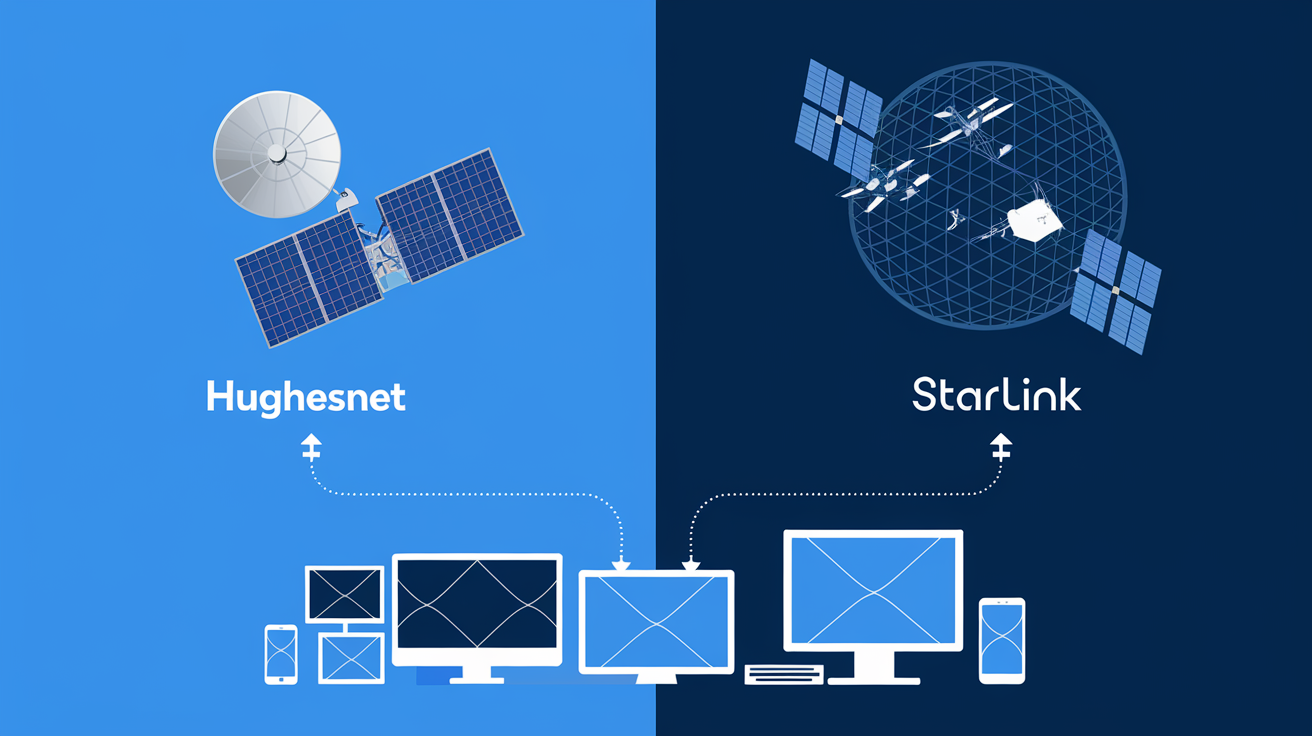
HughesNet vs. Starlink:
Starlink, developed by SpaceX, represents a newer generation of satellite internet. It utilizes a constellation of thousands of satellites in low Earth orbit (LEO), which theoretically offers lower latency and higher speeds compared to traditional geostationary satellites used by HughesNet and Viasat.
- Data Allowances: Starlink's approach to data has evolved. Initially, it was marketed as unlimited. However, as of 2025-26, Starlink has introduced "Standard" and "Priority" plans. The Standard plan typically includes a generous amount of high-speed data (e.g., 1 TB), after which speeds are deprioritized during network congestion. The Priority plan offers a larger amount of high-speed data with less risk of deprioritization. This is a more nuanced "unlimited" than HughesNet's simpler model.
- Speeds: Starlink generally offers significantly higher download and upload speeds than traditional satellite providers like HughesNet, often reaching hundreds of Mbps download. Latency is also considerably lower, making it more suitable for gaming and real-time applications.
- Pricing: Starlink's hardware cost (dish and router) is typically a one-time purchase and can be substantial. Monthly service fees are competitive but can vary by region.
- Availability: Starlink's availability is expanding rapidly but can still be limited in some areas, and waitlists may exist.
- "Unlimited" Interpretation: While Starlink offers large amounts of high-speed data, the deprioritization after a certain threshold on standard plans means it's not strictly "unlimited high-speed" in the same way some fiber plans are. However, the threshold is often much higher than what HughesNet or Viasat offer.
Key Considerations When Comparing:
- Your Specific Location: The best provider and plan depend heavily on what is available and performs best at your address.
- Your Internet Usage Habits: Are you a light user, a moderate streamer, or a heavy gamer/downloader?
- Budget: Compare not just monthly fees but also any upfront hardware costs and contract terms.
- Need for High Speed vs. Basic Connectivity: If you need consistent high speeds for demanding tasks, Starlink or even fixed wireless might be better. If basic connectivity is your primary need and you can manage data, HughesNet or Viasat might suffice.
In essence, while HughesNet offers a form of "unlimited" data by allowing continued service at reduced speeds, other providers like Starlink are pushing the boundaries with higher speeds and more generous data thresholds, albeit with their own forms of network management.
HughesNet Bonus Data Explained
One of the key features that HughesNet uses to enhance its "unlimited" data offering is the inclusion of "Bonus Data." This feature is designed to provide subscribers with additional high-speed data that doesn't count against their primary monthly allowance, offering more flexibility and value. Understanding how Bonus Data works is crucial for maximizing your HughesNet experience.
What is Bonus Data?
Bonus Data is an extra allocation of high-speed data that HughesNet provides to its subscribers. The key characteristic of Bonus Data is that it is typically available for use during specific off-peak hours. This means that when you use Bonus Data, it does not reduce the amount of primary high-speed data you have available for use at any time of the day.
How Does it Work?
HughesNet plans come with a set monthly allowance of primary high-speed data. For example, a plan might offer 100 GB of primary data. In addition to this, the plan might also include, say, 50 GB of Bonus Data. This Bonus Data is usually accessible from 2 AM to 8 AM local time. During these hours, you can use the internet for data-intensive activities like downloading large files, streaming movies, or updating software, and this usage will draw from the 50 GB Bonus Data pool first. Once you've used up your Bonus Data, or if you use the internet outside of these off-peak hours, your usage will then count against your primary 100 GB allowance.
Benefits of Bonus Data:
- Extended High-Speed Access: It effectively increases the total amount of high-speed data you can use each month, albeit during specific times.
- Reduced Strain on Primary Allowance: By shifting heavy data usage to off-peak hours, you can conserve your primary data allowance for when you need it most during peak times.
- Cost-Effective for Heavy Users: For users who need to download large files or perform other data-intensive tasks, Bonus Data provides a way to do so without immediately depleting their main data cap.
- Enhanced "Unlimited" Experience: It adds another layer to HughesNet's "unlimited" offering, providing more high-speed capacity than the primary allowance alone would suggest.
Maximizing Bonus Data Usage:
To get the most out of your HughesNet plan, it's highly recommended to leverage your Bonus Data. Here are some strategies:
- Schedule Downloads: Set your computers and devices to download large files, software updates, or game patches overnight during the Bonus Data hours.
- Stream Movies and Shows: If you plan to watch several movies or binge-watch a series, consider doing so during the off-peak hours.
- Back Up Your Data: Cloud backups can consume significant data. Schedule these to run during Bonus Data hours.
- Perform System Updates: Operating system and application updates can be large. Let them download overnight.
Important Considerations:
- Specific Hours Vary: The exact hours for Bonus Data access can vary slightly by plan or region, so always check your specific HughesNet plan details.
- Bonus Data is Still High-Speed: While it's a separate pool, it is still high-speed data. Once it's used up, you revert to your primary allowance or reduced speeds if both are exhausted.
- Not a Substitute for Primary Data: Bonus Data is a supplement, not a replacement, for your main data allowance. You still need to manage your primary data usage carefully.
In the context of the question "Does HughesNet have unlimited internet?", the Bonus Data feature is a significant part of the answer. It provides a substantial amount of additional high-speed data, making the overall service feel more generous and less restrictive for users who can adapt their usage patterns.
Is HughesNet Truly Unlimited? The Verdict
After dissecting HughesNet's data policies, plans, and user experiences, we arrive at a definitive answer to the question: Does HughesNet have unlimited internet? The answer is nuanced: Yes, but with significant caveats.
HughesNet offers what is commonly referred to as "unlimited" data, but this does not mean an infinite amount of high-speed data without any limitations. Instead, their model provides:
- A Generous Monthly High-Speed Data Allowance: Each plan comes with a substantial amount of data that you can use at full advertised speeds.
- Continued Service After Allowance: Once you consume your primary high-speed data allowance, your internet service does not get cut off.
- Reduced Speeds: Your internet speeds will be significantly reduced for the remainder of the billing cycle. This is often referred to as throttling or deprioritization.
- Bonus Data: Many plans include additional high-speed data that can be used during off-peak hours without impacting your primary allowance.
Therefore, if "unlimited" means you will never lose internet access and won't face overage charges, then HughesNet fits the description. However, if "unlimited" implies consistent, high-speed data for all your online activities at any time of the day, then HughesNet does not offer that. The reduced speeds after exceeding your data allowance can make activities like streaming HD video, online gaming, and large downloads very slow or impractical.
Who is HughesNet's "unlimited" best suited for?
- Rural residents who have limited or no other broadband options.
- Light to moderate internet users who primarily use the internet for email, web browsing, social media, and occasional video calls.
- Users who can adapt their habits to utilize Bonus Data during off-peak hours for heavy data tasks.
- Those who prioritize continuous connectivity over consistently high speeds for all activities.
Who might find HughesNet's "unlimited" restrictive?
- Heavy streamers of HD or 4K video.
- Online gamers who require low latency and consistent high speeds.
- Users who frequently download large files (e.g., software developers, graphic designers).
- Households with multiple users engaging in data-intensive activities simultaneously.
- Anyone seeking truly unlimited, high-speed data without any speed reductions.
In conclusion, HughesNet provides a vital service for many, offering a form of unlimited internet that ensures connectivity even after a primary data allowance is used. However, it's crucial to understand the limitations, particularly the speed reductions. By managing your data usage effectively, leveraging Bonus Data, and setting realistic expectations, you can determine if HughesNet's "unlimited" offering is the right fit for your needs. For those requiring uninterrupted high speeds, exploring alternatives like cable, fiber, or potentially newer satellite technologies like Starlink (with its own data management policies) would be advisable if available in your area.
Does Hughesnet have unlimited internet?
Research, Compare & Choose With Confidence
Last updated: June 25, 2026