-
Posted on: 07 Jan 2026

-
HughesNet, a prominent satellite internet provider, is frequently asked about its data plans. Many users searching "Does Hughesnet offer an unlimited plan?" are seeking relief from restrictive data caps. This article dives deep into HughesNet's offerings, clarifying their approach to data and exploring options that provide a more expansive internet experience for 2025-26.
Understanding HughesNet Data Plans
In the realm of internet service providers, data allowances are a critical factor for consumers, especially those in areas with limited broadband options. HughesNet, as a satellite internet provider, operates under a unique set of circumstances that influence how it structures its data plans. Unlike terrestrial services like fiber or cable, satellite internet involves transmitting data over long distances through space, which can lead to inherent latency and bandwidth considerations. This technical architecture often dictates a more structured approach to data usage. For users who find themselves asking, "Does HughesNet offer an unlimited plan?", it's crucial to understand that their service model, while evolving, has historically been built around defined data allowances rather than truly unlimited, unthrottled access. This doesn't mean there aren't ways to get a lot of internet for your buck, but it requires a clear understanding of their terminology and how their network is managed. In 2025-26, HughesNet continues to refine its offerings, aiming to provide reliable connectivity to underserved regions, but the concept of "unlimited" needs careful examination within their specific context.
The Truth About HughesNet "Unlimited" Plans
The term "unlimited" in internet service can be misleading, and this is particularly true for satellite providers like HughesNet. When you see "unlimited" advertised, it often comes with caveats, such as "unlimited data with reduced speeds after a certain threshold" or "unlimited data during off-peak hours." For HughesNet in 2025-26, their plans are not strictly "unlimited" in the sense that you can download and upload as much as you want at full speed without any consequences. Instead, they operate with a generous data allowance, often referred to as "priority data," and then transition to a lower-speed tier for the remainder of the billing cycle once that allowance is exhausted. This approach is designed to ensure a baseline level of service for all subscribers on the network, preventing any single user from monopolizing bandwidth and impacting others. Therefore, while HughesNet aims to provide ample data for most users, it's essential to clarify what "unlimited" means in their specific plan structures to avoid unexpected slowdowns.
What Does HughesNet Mean by "Unlimited"?
HughesNet's interpretation of "unlimited" data typically revolves around two key components: a substantial monthly data allowance (priority data) and the ability to continue using the internet, albeit at reduced speeds, after that allowance is met. This strategy is common in satellite internet because the available bandwidth is more constrained compared to cable or fiber. The goal is to provide a consistent, albeit slower, experience for all users, rather than having service become completely unusable for some when network congestion occurs. In 2025-26, this model remains largely in place. Users are encouraged to manage their high-bandwidth activities within their priority data window to ensure the best possible performance. Understanding this distinction is crucial for managing expectations and making informed decisions about your internet usage.
Why Satellite Internet Differs
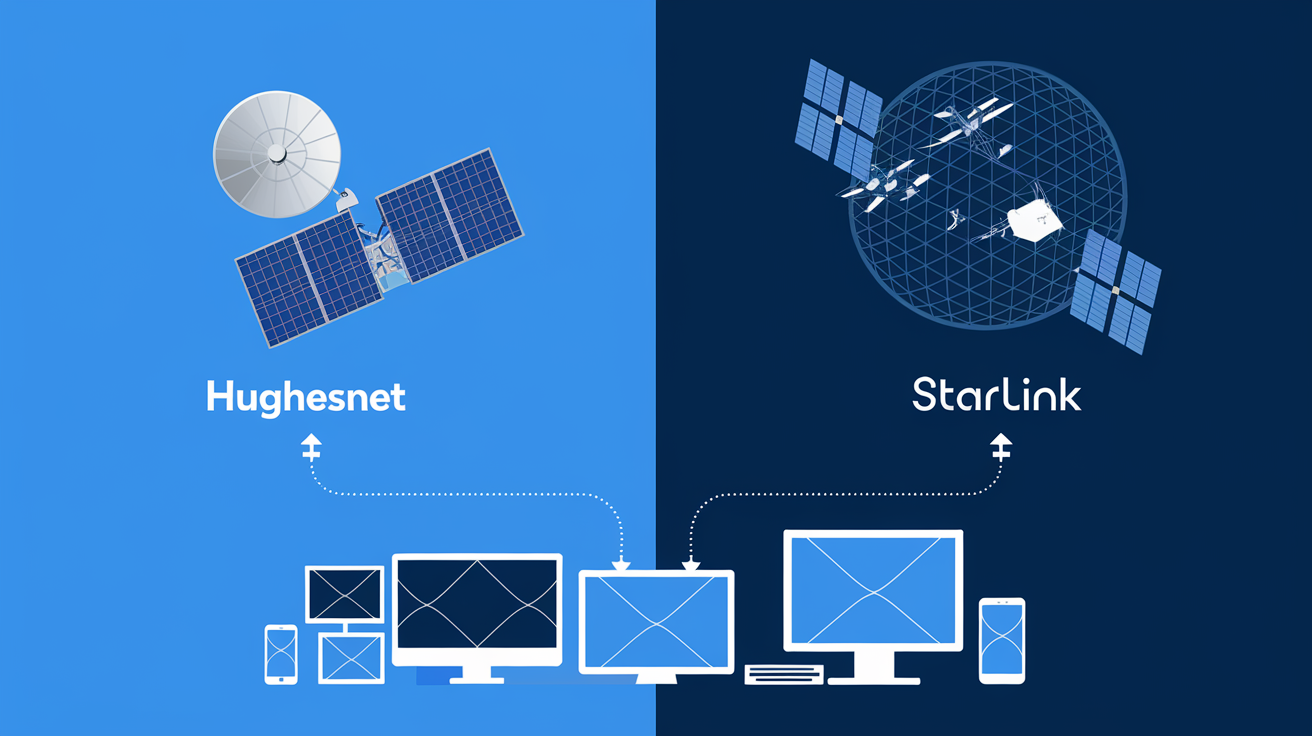
Satellite internet's fundamental difference lies in its transmission method. Data travels from your home to a satellite in orbit, then back down to a ground station, and finally to its destination. This long path introduces inherent latency. More importantly, the total bandwidth available to a satellite dish is shared among many users in a geographic area. Unlike cable or fiber, where individual connections are more isolated, satellite networks are more susceptible to congestion. When many users are online simultaneously, especially during peak hours, the available bandwidth must be divided more thinly. This is why satellite providers often implement data caps or speed reductions after certain usage thresholds. It's a network management technique to ensure a more equitable distribution of resources and prevent the service from becoming unusable for everyone. For 2025-26, these physical and technical limitations continue to shape HughesNet's service structure.
HughesNet Data Allowance Explained
To truly understand HughesNet's data offerings, it's vital to dissect their terminology. They don't offer a simple "unlimited" data plan without conditions. Instead, their plans are built around a core concept of priority data, supplemented by features like the Bonus Zone and data rollover. This tiered approach aims to balance generous data access with network stability. For 2025-26, these elements are key to grasping how much data you can realistically expect to use and at what speeds.
Priority Data
Priority data is the cornerstone of HughesNet's plans. This is the amount of data you can use each month at the highest available speeds. Think of it as your main data allowance. Once you exceed this priority data threshold, your internet speeds will be reduced for the remainder of your billing cycle. The amount of priority data varies depending on the specific HughesNet plan you choose. For example, plans might offer 100GB, 150GB, or even 200GB of priority data per month. This is the data you'll want to reserve for your most critical and high-bandwidth activities, such as streaming HD video, downloading large files, or engaging in extensive online gaming. In 2025-26, understanding the exact GB amount for your chosen plan is the first step to managing your internet experience effectively.
What Happens When Priority Data is Exceeded?
When you use up your priority data allowance, HughesNet doesn't cut you off. Instead, your internet speeds are significantly reduced. This is often referred to as "deprioritization." While you can still access the internet, activities that require substantial bandwidth, like streaming video, video conferencing, or downloading large files, will become very slow, potentially to the point of being unusable. This is a standard practice for satellite internet providers to manage network resources. The reduced speeds are typically sufficient for basic web browsing, checking email, or using social media, but they are not ideal for data-intensive tasks. For 2025-26, users should anticipate this slowdown and plan their high-usage activities accordingly.
Bonus Zone
HughesNet offers a feature called the "Bonus Zone," which provides additional data that can be used during off-peak hours, typically overnight. This data does not count against your monthly priority data allowance. For instance, you might get an extra 50GB or 100GB of data that is available from 2 AM to 8 AM local time. This is an excellent opportunity to schedule large downloads, software updates, or system backups without impacting your primary data cap. By strategically utilizing the Bonus Zone, users can significantly extend their usable data for the month and reduce the likelihood of hitting their priority data limit. In 2025-26, this feature remains a valuable tool for HughesNet subscribers looking to maximize their data usage.
How to Leverage the Bonus Zone
To make the most of the Bonus Zone, users should configure their devices and applications to perform data-intensive tasks during these off-peak hours. This includes setting automatic updates for operating systems and applications to run overnight, scheduling cloud backups for photos and documents, and downloading movies or large files when the network is less congested. Many modern operating systems and applications have built-in scheduling features that can be easily configured. For example, Windows Update can be set to install updates during specific times, and many cloud storage services allow for manual or scheduled synchronization. By embracing this feature, users can effectively increase their overall monthly data capacity without incurring extra charges or facing speed reductions during peak usage times.
Data Rollover
Another feature that enhances data flexibility is data rollover. HughesNet allows unused priority data from one month to be carried over to the next. This means if you don't use all of your priority data in a given month, the remaining amount will be added to your allowance for the following month. There's typically a limit to how much data can be rolled over, often equivalent to one month's allowance. This feature is particularly beneficial for households with fluctuating internet usage patterns. For example, if you have a month with lower-than-average usage, you'll have a larger data pool available for the next month, providing a buffer for more data-intensive activities. In 2025-26, data rollover offers an added layer of flexibility for HughesNet customers.
Understanding Rollover Limits
It's important to note that data rollover typically applies only to the priority data portion of your plan. Data used in the Bonus Zone or any data that might be incurred after exceeding your priority data allowance generally does not roll over. Also, there's usually a cap on how much data can be rolled over, often matching your monthly priority data allowance. For instance, if your plan has 100GB of priority data and you only use 70GB one month, you might be able to roll over up to 30GB, giving you 130GB for the next month. However, if you then use 120GB the following month, you'd still have 10GB left, but that remaining 10GB would not roll over again if your plan's rollover limit is 100GB. Always check your specific plan details for exact rollover policies and limits.
How HughesNet Manages Data
HughesNet employs several strategies to manage its network and ensure a reasonable experience for all subscribers, especially given the inherent limitations of satellite technology. These management practices are key to understanding why truly unlimited, high-speed data is not a standard offering. For 2025-26, these methods remain central to their service delivery.
Network Prioritization
The core of HughesNet's data management is network prioritization. As mentioned, your "priority data" is the amount you can use at full speeds. Once this limit is reached, your traffic is "deprioritized." This doesn't mean your internet stops working, but rather that your data packets are placed lower in the queue when the network is congested. This ensures that users who are still within their priority data allowance receive the best possible speeds. This system is essential for maintaining a functional service for everyone on the shared satellite network.
Fair Use Policy
While HughesNet doesn't explicitly advertise a "fair use policy" in the same way some mobile carriers do, their data allowance structure effectively serves the same purpose. By setting a limit on high-speed data, they encourage responsible usage and prevent extreme consumption by a few users from negatively impacting the experience of many. This policy is in place to ensure that the limited bandwidth available through satellite is shared as equitably as possible. For 2025-26, this policy underpins their data management strategy.
Throttling vs. Data Caps
It's important to distinguish between throttling and hard data caps. A hard data cap would mean your internet service completely stops once you reach a certain usage limit, until the next billing cycle or you purchase more data. HughesNet, in contrast, primarily uses throttling after you've used your priority data. This means your speeds are reduced, but you can still access the internet. This approach is generally more user-friendly than a hard cap, as it avoids complete service interruption. However, the reduced speeds can be frustrating for data-intensive activities. For 2025-26, this distinction remains a key characteristic of their service.
Alternatives to HughesNet for Truly Unlimited Data
If your primary requirement is truly unlimited, unthrottled internet access, and you have access to other broadband technologies, HughesNet might not be the ideal solution. Satellite internet, by its nature, has limitations that make offering unlimited high-speed data challenging. Fortunately, several other internet technologies can provide this flexibility. For 2025-26, these alternatives are increasingly available and offer superior performance for data-heavy users.
Fiber Optic Internet
Fiber optic internet is widely considered the gold standard for broadband. It uses light pulses transmitted through thin strands of glass to deliver data, offering incredibly high speeds and virtually unlimited bandwidth. Most fiber plans come with unlimited data and no throttling. If fiber is available in your area, it's almost always the best option for speed, reliability, and data freedom.
Cable Internet
Cable internet, delivered over coaxial cables, is another popular and often high-speed option. While some cable plans might have data caps, many providers now offer unlimited data plans, especially at higher speed tiers. Cable internet generally offers lower latency than satellite and is more widely available. It's a strong contender for users seeking unlimited data without the limitations of satellite.
5G Home Internet
With the expansion of 5G wireless networks, 5G home internet has emerged as a viable alternative, particularly for those in areas underserved by traditional broadband. Many 5G home internet plans offer unlimited data with no data caps or throttling. Speeds can vary depending on network congestion and signal strength, but it can provide a competitive option for many households.
Fixed Wireless Internet
Fixed wireless internet uses radio signals to connect a fixed location (like your home) to a nearby tower. It's often available in rural or suburban areas where other broadband options are limited. Some fixed wireless providers offer unlimited data plans. Performance can depend on factors like distance to the tower and line-of-sight, but it can be a good alternative to satellite for some users.
Maximizing Your HughesNet Data
Even with HughesNet's data allowances and features like the Bonus Zone, smart usage habits can help you stay within your priority data limits and enjoy a better internet experience. For 2025-26, these tips are invaluable for any HughesNet subscriber.
Optimize Streaming Settings
Streaming video is one of the biggest data consumers. Most streaming services (like Netflix, Hulu, YouTube) allow you to adjust the video quality. Lowering the resolution from HD (1080p) or 4K to standard definition (SD) can drastically reduce data usage. For example, streaming in SD might use around 0.7GB per hour, while HD can use 3GB per hour, and 4K can consume upwards of 7GB per hour. If you're trying to conserve data, opt for lower resolutions, especially during peak hours.
Manage Background Data
Many applications and operating systems use data in the background without your direct interaction. This includes automatic updates, cloud syncing services (like Google Drive, Dropbox, iCloud), and app refresh features. Review your device settings to limit background data usage. You can often disable automatic updates for apps, pause cloud syncing when not needed, or restrict background activity for specific applications.
Use Data-Saving Browsers and Extensions
Some web browsers and browser extensions are designed to compress web pages and images, thereby reducing the amount of data downloaded. For example, Google Chrome has a "Lite mode" (though this is being phased out in favor of more efficient rendering), and Opera has a built-in data-saving mode. Extensions like "Data Saver" can also help by blocking unnecessary scripts and compressing images.
Monitor Your Data Usage
HughesNet provides tools to monitor your data usage. Regularly checking your data consumption through your HughesNet account portal or mobile app is crucial. This allows you to see how much priority data you have remaining, how much you've used from the Bonus Zone, and when your data resets. Proactive monitoring helps you avoid exceeding your limits and understand which activities consume the most data.
HughesNet Plan Overview (2025-26)
While specific plan names and data allowances can change, HughesNet typically offers several tiers of service designed to cater to different needs and budgets. As of 2025-26, you can expect plans to feature varying amounts of priority data, with higher tiers offering more. For instance, a typical HughesNet plan might look something like this:
Plan Name (Example) Priority Data Allowance Bonus Zone Data Speeds After Priority Data Typical Price Range (Monthly) HughesNet Satellite Basic 100 GB 50 GB (2 AM - 8 AM) Reduced Speeds (e.g., 1-3 Mbps) $65 - $85 HughesNet Satellite Plus 150 GB 100 GB (2 AM - 8 AM) Reduced Speeds (e.g., 1-3 Mbps) $80 - $100 HughesNet Satellite Premium 200 GB 100 GB (2 AM - 8 AM) Reduced Speeds (e.g., 1-3 Mbps) $100 - $120 Note: Prices and specific data allowances are illustrative and subject to change by HughesNet. Always check the official HughesNet website for the most current plan details and pricing in your area.
It's important to reiterate that none of these are truly "unlimited" plans in the sense of unthrottled, high-speed access at all times. The priority data is the key metric to watch. The Bonus Zone data offers a significant advantage for off-peak usage, and data rollover adds further flexibility. When evaluating these plans for 2025-26, consider your typical monthly data consumption. If you consistently exceed the priority data allowance, you will experience slower speeds.
Is HughesNet the Right Choice for You?
The question "Does HughesNet offer an unlimited plan?" is best answered by understanding their data structure: they offer generous data allowances with a Bonus Zone and data rollover, but not unlimited high-speed data. For individuals or households in areas where no other broadband options are available, HughesNet can be a lifeline. Its satellite technology makes it accessible virtually anywhere with a clear view of the sky.
However, if you are a heavy internet user, frequently stream in high definition, download large files, or engage in online gaming, the limitations on high-speed data might become a significant drawback. In such cases, exploring alternatives like fiber, cable, or even 5G home internet, if available, would be a more suitable choice for achieving truly unlimited, high-performance internet access. For 2025-26, the landscape of internet availability continues to expand, making it crucial to assess all your options.
Ultimately, the decision hinges on your specific needs, your location, and your tolerance for potential speed reductions after exceeding your priority data. By understanding the nuances of HughesNet's data plans, you can make an informed choice that best fits your internet usage habits and expectations.
In conclusion, HughesNet does not offer a truly unlimited high-speed internet plan in the traditional sense. Their service is characterized by a substantial monthly priority data allowance, a valuable Bonus Zone for off-peak usage, and data rollover capabilities. While these features aim to provide ample data for most users, exceeding the priority data threshold will result in reduced speeds for the remainder of the billing cycle. For those requiring unthrottled, high-speed internet without any data limitations, exploring alternatives such as fiber optic, cable, or 5G home internet is recommended if available. However, for individuals in underserved areas where satellite is the primary or only option, HughesNet's plans can provide a viable, albeit managed, internet experience. Carefully assess your data needs and compare HughesNet's offerings against other available technologies to determine the best fit for your household in 2025-26.